People & Characters
Albert Einstein
Albert Einstein was a theoretical physicist whose work reshaped modern understanding of light, gravity, space, time, energy, and matter.
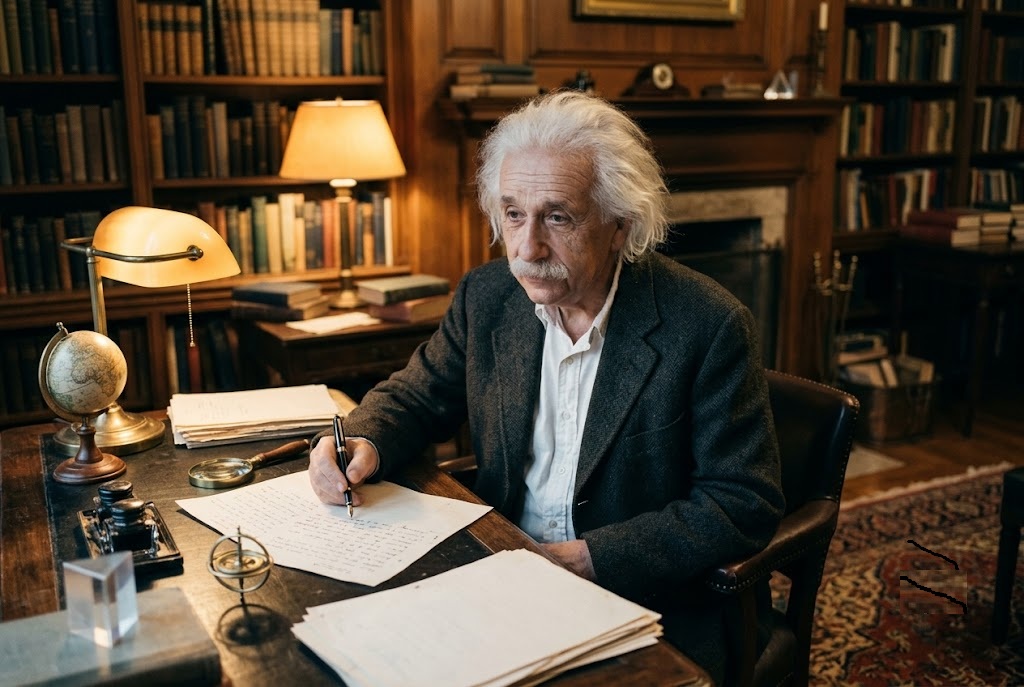
Albert Einstein was a German-born theoretical physicist whose ideas transformed modern physics. Born in Ulm on March 14, 1879, he developed special relativity, explained the photoelectric effect using light quanta, and established the relationship between mass and energy. His work changed scientific views of space, time, matter, light, and gravity.
Einstein received the 1921 Nobel Prize in Physics, especially for discovering the law of the photoelectric effect. After leaving Germany during the rise of the Nazi regime, he settled in the United States and joined the Institute for Advanced Study in Princeton, where he remained until his death in 1955.
Quick facts
- Einstein was born in Ulm, Germany, on March 14, 1879.
- His 1905 work included special relativity and an explanation of the photoelectric effect using light quanta.
- The equation E = mc² expresses the equivalence of mass and energy.
- He received the 1921 Nobel Prize in Physics, especially for the law of the photoelectric effect.
- Einstein became a faculty member at the Institute for Advanced Study in Princeton in 1933.
A surprising fact
Einstein's Nobel Prize citation emphasized the photoelectric effect rather than his theories of relativity.