Science & Space
Black Hole
A black hole is an extremely dense astronomical object whose gravity creates a boundary beyond which even light cannot escape.
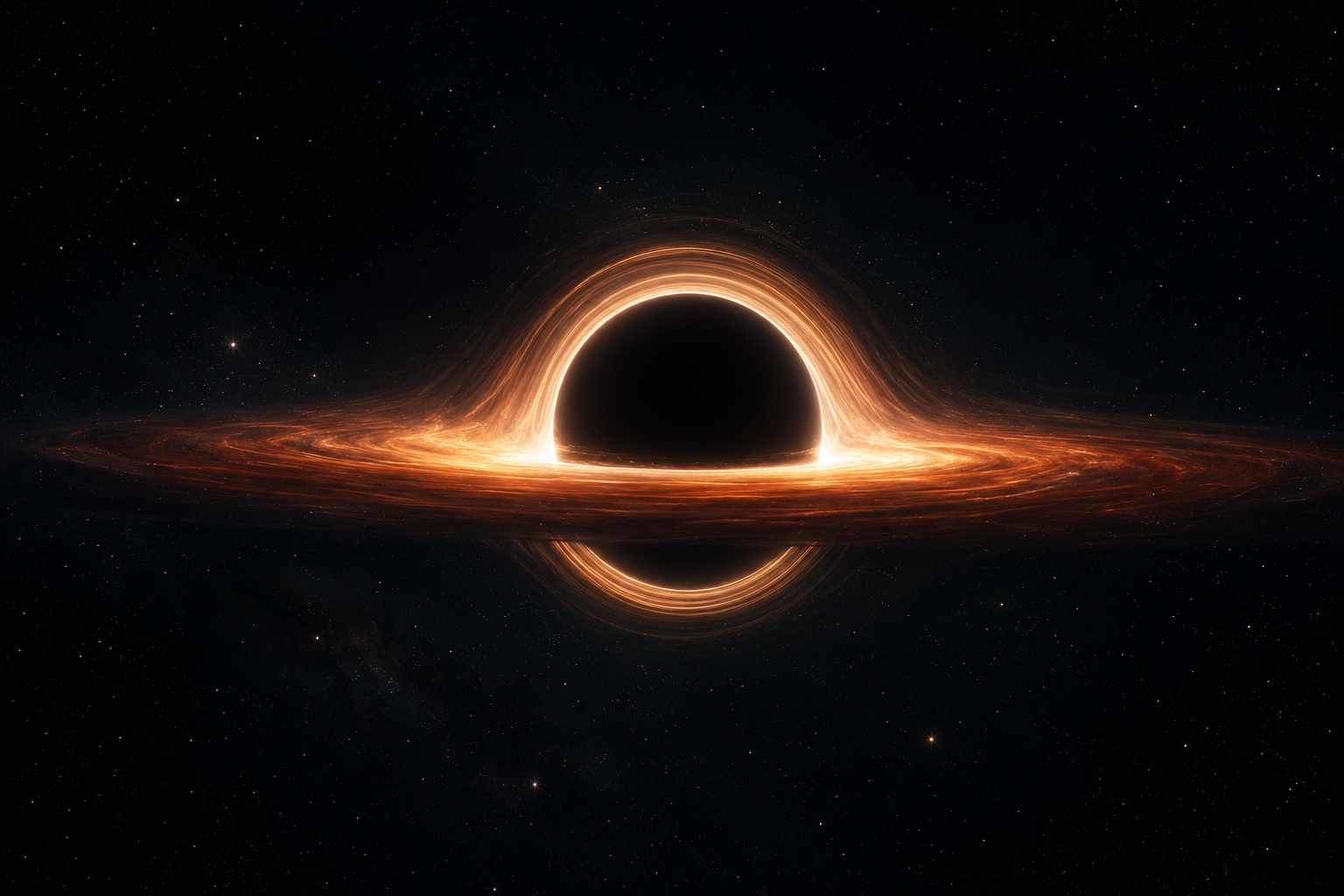
A black hole is not a literal hole but an enormous concentration of matter compressed into a very small region. Its event horizon marks a boundary beyond which nothing, including light, can return to an outside observer. Because black holes neither emit nor reflect light, astronomers study their effects on nearby matter, radiation, and the motion of surrounding objects.
Black holes occur in several mass ranges, including stellar-mass, intermediate-mass, and supermassive black holes. Some form when the cores of massive stars collapse, while supermassive black holes occupy the centers of most large galaxies. Scientists are still investigating how the earliest and largest examples formed.
Quick facts
- The event horizon is the boundary beyond which the speed needed to escape a black hole exceeds the speed of light.
- Astronomers generally classify black holes as stellar-mass, intermediate-mass, or supermassive according to their mass.
- A stellar-mass black hole can form after the core of a sufficiently massive star collapses.
- Nearly every large galaxy, including the Milky Way, contains a supermassive black hole near its center.
- In 2019, the Event Horizon Telescope released the first image of a black hole's shadow, created from observations of the galaxy M87.
A surprising fact
If the Sun were hypothetically replaced by a black hole of the same mass, Earth's orbit would remain unchanged, although sunlight would disappear.