Science & Space
Northern Lights
Colorful atmospheric displays produced when energetic particles interact with gases above Earth's northern polar region.
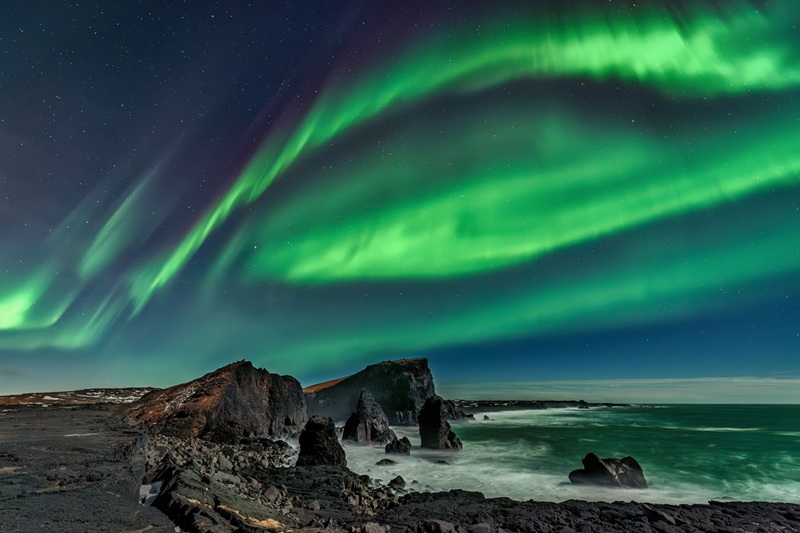
The northern lights, also called the aurora borealis, are shifting displays of colored light in Earth's upper atmosphere. They form when energetic particles associated with the solar wind are guided by Earth's magnetic field toward the polar atmosphere. Collisions with oxygen and nitrogen transfer energy to those gases, which release the energy as visible light.
Auroras usually appear within oval-shaped regions centered near Earth's magnetic poles. The northern display is most frequently observed at high latitudes, especially under clear, dark skies. During strong geomagnetic storms, the auroral oval can expand toward lower latitudes, allowing people much farther south to see the lights.
Quick facts
- Northern Hemisphere auroras are called the aurora borealis or northern lights; southern auroras are called the aurora australis.
- The aurora typically forms between about 80 and 500 kilometers above Earth's surface.
- Green is the most common auroral color and is produced by excited oxygen roughly 100 to 200 kilometers above Earth.
- Auroral ovals are approximately centered on Earth's magnetic poles rather than its geographic poles.
- Major geomagnetic storms can expand the northern auroral oval far enough for the lights to appear across much of the United States, Europe, and Asia.
A surprising fact
Auroras are not unique to Earth; scientists have also observed them on planets including Jupiter and Saturn.