Science & Space
International Space Station
The International Space Station is a crewed research laboratory assembled in orbit through cooperation among several national and international space agencies.
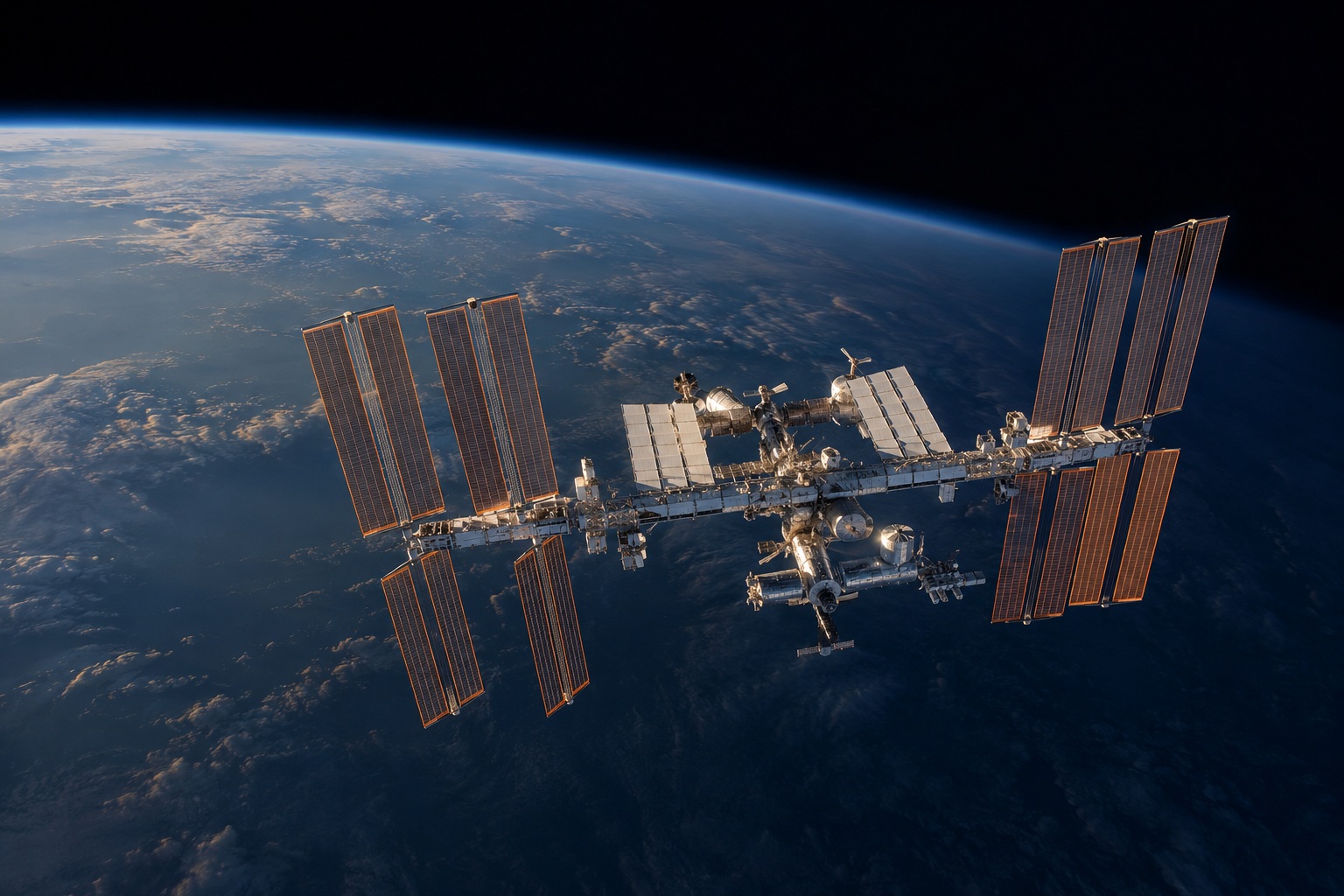
The International Space Station is a large human-made spacecraft and laboratory in low Earth orbit. International partners assembled it from separately launched modules, beginning with the Zarya module in 1998. Crews have lived aboard continuously since November 2, 2000, conducting scientific research and testing technologies for life and work beyond Earth.
The station travels about 250 miles above Earth at roughly 17,500 miles per hour, completing an orbit in about 90 minutes. Its international partners include NASA, Roscosmos, the European Space Agency, the Japan Aerospace Exploration Agency, and the Canadian Space Agency.
Quick facts
- The Zarya module, the first component of the station, launched on November 20, 1998.
- The station has been continuously inhabited since the Expedition 1 crew arrived on November 2, 2000.
- It travels at approximately 17,500 miles per hour and completes an orbit about every 90 minutes.
- NASA, Roscosmos, ESA, JAXA, and CSA have contributed to the station and its operations.
- Large modules and other station components were delivered during 42 assembly flights.
A surprising fact
Because the station circles Earth about 16 times each day, its crew experiences approximately 16 sunrises and 16 sunsets every 24 hours.