Science & Space
Solar Eclipse
A solar eclipse occurs when the Moon passes between the Sun and Earth and blocks some or all sunlight for observers in certain areas.
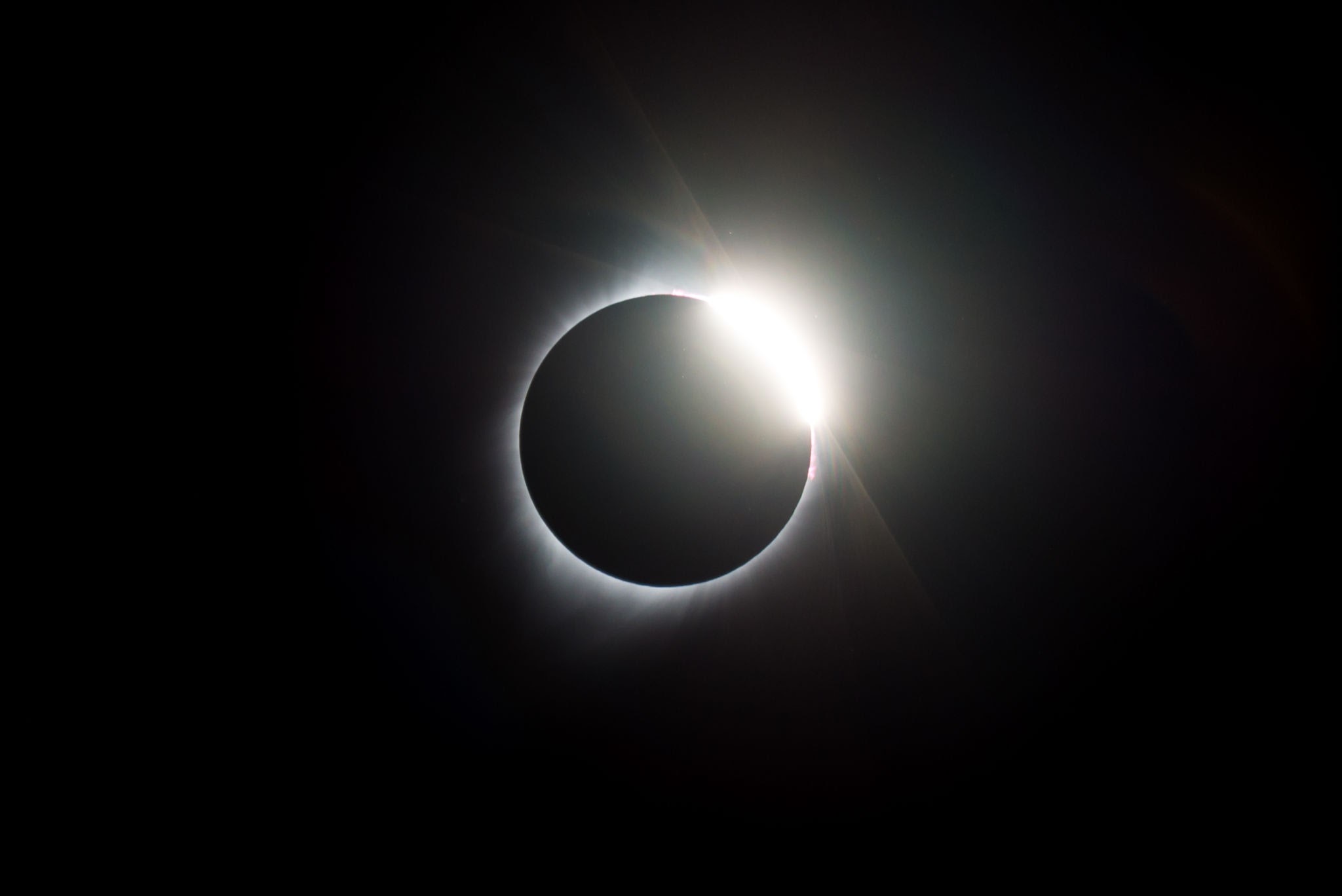
A solar eclipse happens when the Moon passes between the Sun and Earth, casting a shadow on part of Earth's surface. From locations inside that shadow, the Moon appears to cover some or all of the Sun. Solar eclipses occur only near the new Moon phase.
The main types are total, annular, partial, and hybrid eclipses. During totality, the Moon completely covers the Sun's bright face and the normally hidden corona becomes visible. During an annular eclipse, the Moon appears too small to cover the entire Sun, leaving a bright ring.
Quick facts
- A solar eclipse occurs when the Moon moves between the Sun and Earth.
- Solar eclipses can occur only near the new Moon phase.
- The four recognized types are total, annular, partial, and hybrid solar eclipses.
- A total eclipse reveals the Sun's corona to observers within the path of totality when skies are clear.
- Eclipse seasons occur about twice each year because the Moon's orbit is tilted relative to Earth's orbit around the Sun.
A surprising fact
A hybrid solar eclipse can appear total from some locations and annular from others because Earth's surface is curved.